
THE ESSAY ISN'T DEAD
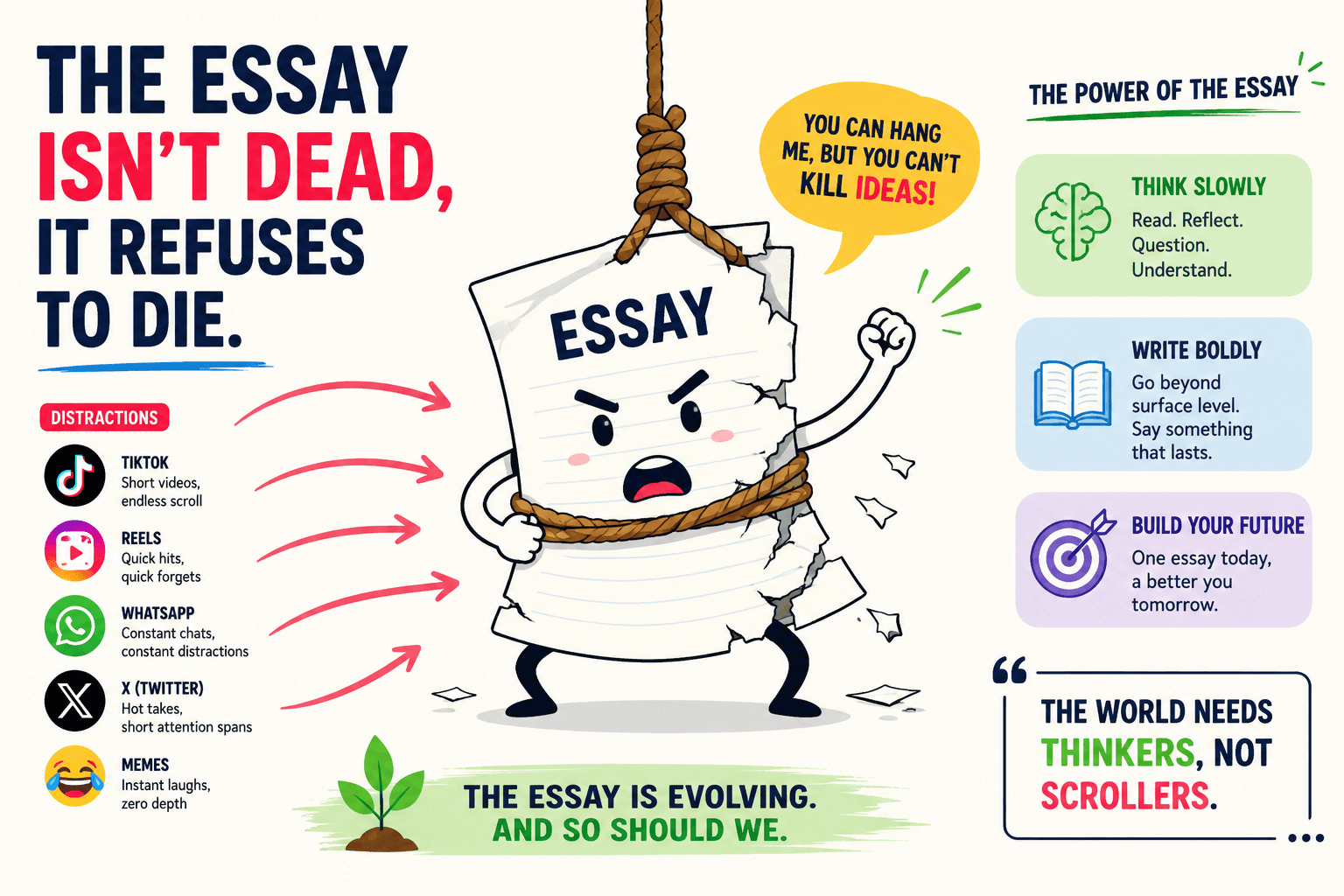
Last month, during my JAMB preparation break, I tried to read a 2,000-word article about the ASUU strike. I got to the third paragraph, saw my WhatsApp notification light up, and told myself, "I'll come back to it." I never did. Three days later, I watched a two-minute TikTok video that summarized the entire strike instead.
That moment stayed with me. In 2018, my English teacher in JSS2 used to say, "If you can write an essay, you can think." Every Friday, we wrote 500-word essays on topics like The Value of Education or Corruption in Nigeria. I hated those assignments then. But now, in 2026, as I prepare for university, I realize those Friday essays may have been the last time anyone deliberately forced me to think slowly.
And slowly, the essay itself is dying.
1. Our Attention Spans Can't Carry It Anymore
Let's be honest: most of us don't finish long articles.
We grew up with TikTok, Instagram Reels, and WhatsApp Status. Even the news now reaches us through three-slide carousels. On X, if a thread doesn't begin with something catchy, many people simply scroll past.
I'm guilty too. I'll open a long article, read the introduction, then switch to a comedy skit. The apps we use train us to consume information quickly, and writers adapt to that reality. Why spend two weeks writing one thoughtful essay when ten short posts will attract more views?
As a result, we end up knowing a little about everything but not enough about anything.
2. School Taught Us the Wrong Version of Essays
In secondary school, essay writing was reduced to a formula: introduction, three body paragraphs, and a conclusion. We were told not to use "I," never to go off-topic, and that five paragraphs equaled twenty marks.
Nobody explained that essays could be exploratory—that you could begin with uncertainty and end with better questions. Essays became examination tools rather than opportunities for critical thinking.
Today, students often submit Canva presentations and one-minute videos instead. Those formats are valuable, but we're gradually losing the ability to develop and sustain a complex argument over 1,000 words—the very skill university education demands.
3. Too Many Essays, Thanks to AI
Ironically, there are more essays today than ever before. Platforms like Substack, Medium, LinkedIn, and even X are filled with long-form content. Now, artificial intelligence can produce an essay in seconds.
But abundance has created noise. When everything begins to sound the same, readers lose interest. Many articles feel as though they exist simply to fill space rather than offer meaningful insight.
As a result, people return to quicker forms of content: memes, short videos, trending stories, and hot takes.
We didn't run out of essays—we became overwhelmed by them.
4. The Essay Isn't Dead; It Just Changed Clothes
The essay still exists—it has simply taken new forms.
My friends at university don't regularly read newspaper essays. Instead, they watch twenty-minute YouTube analyses of Nigerian politics or the economy. That's essentially an essay with narration.
People subscribe to newsletters. On X, writers turn a single idea into a twenty-post thread. On Instagram, arguments unfold across ten-slide carousels.
The structure remains the same: a central idea, supporting evidence, and a conclusion. We've simply divided it into smaller, more digestible pieces.
What's disappearing isn't the essay itself, but the expectation that everyone will read long-form writing by default.
5. Why This Should Worry Us as Future University Students
University won't grade us on TikTok videos. It will expect sustained thinking.
You cannot properly analyze Chimamanda Ngozi Adichie's works, debate Nigeria's economy, or understand climate change in 280 characters. Social media posts may express opinions, but essays reveal the reasoning behind those opinions.
If we lose the essay, we lose our patience for complexity. We risk becoming people with strong opinions but weak reasoning—quick to react, slow to investigate. That is not the kind of graduate Nigeria needs.
Conclusion
The essay isn't dead. It's like vinyl records in the age of music streaming—slower, less convenient, but ultimately richer.
If we want it to survive, we must choose it. As writers, we should move beyond rigid WAEC templates and write with curiosity and originality. As readers, we should commit to finishing at least one thoughtful long-form article every week—without skipping to the end. Because if we can still think slowly, perhaps the essay will never truly die.
About the Author

Modiline Okoronkwo Hapuruchi is a Nigerian student, writer, and thinker with a passion for education, communication, and the evolution of ideas. Through thoughtful and engaging writing, she hopes to inspire thousands of readers to think critically, embrace knowledge, and create meaningful change.